
Orchard Room
Welcome to the Orchard Room.
Be Trustworthy: “Tell the truth to each other.” Zechariah 8.16
'A Nurture Room is a place within the school where children are free to express themselves. The aim is to effectively address the children's needs and prevent exclusion from the classroom and any distress caused by them not having the coping skills, through no fault of their own.'
Nurture Provision
Nurture groups are a short-term, focused intervention for around 6-12 children, led by a Mrs Bradley and member of support staff. The Nurture Group is part of the school’s Inclusion and PSHE (Personal, Social and Health Education) provision. Children attending the nurture group remain an active part of their main class, spending appropriate times within the nurture group according to their need, and typically return full time to their own class within two to four terms.
Nurture groups assess learning and social and emotional needs and give help that is needed to remove any barriers to learning. The relationship between the staff is always nurturing and supportive, providing a role model for children. Food is shared at ‘snack time’ with much opportunity for social learning, helping children to attend to the needs of others, with time to listen and be listened to.
As the children learn academically and socially, they develop confidence, become responsive to others, learn self-respect and take pride in their relationships and in achieving.
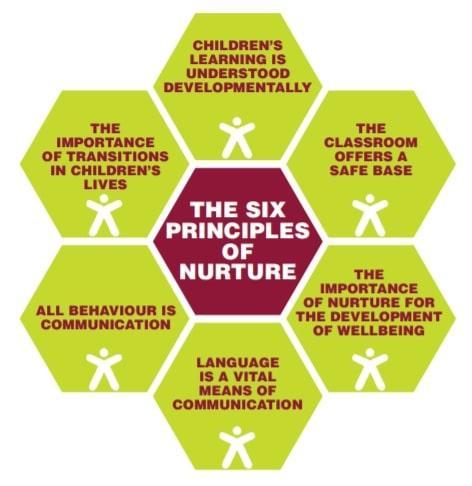
The Principles of Nurture:
The philosophy of the Orchard Room is drawn from the principles established by the work of Marjorie Boxall and others, and exemplified by ‘The Nurture Group Network’ (www.nurturegroups.org).
The Nurture Group Principles:
- Children’s learning is understood developmentally
- The classroom offers a safe base
- All behaviour is communication
- The importance of transition in children's lives
- Has an adult/child ration of 1:3, and provides lots of opportunities for speaking and listening activities
- Builds a child’s self-esteem and confidence
- Builds skills for classroom learning
- Has daily crafts, games, a ‘mini-tea’ and more!
- Language is a vital means of communication
Before children attend nurture provision parents are informed by letter and requested to sign a permission slip.
The Story So Far…
The Orchard Room has developed over the years. As well as providing Nurture Group provision for our pupils, we are also able to provide other types of wellbeing support in The Orchard for the wider school e.g. Lunch Time Haven, friendship groups, as well as 1-1 support for identified pupils.
The children who come get to practise all their new skills with their own class. We share news, explore through play, how to talk about our feelings and to explore new skills in free play.
Each afternoon group has a different theme or themes to explore, depending on the children who attend e.g. friendship, enterprise, play, teamwork, self-esteem, loss or change.
Each child who attends comes for their own individual reasons, however, it is our hope that each child leaves The Orchard with a bank of coping strategies and skills for dealing positively with whatever life throws at them!
Who do we help
Children may attend sessions in the Nurture Group for specific reasons, for example:
- Friendship difficulties – keeping/making friends
- Quiet, shy, withdrawn
- Find it hard to listen to others or join in
- Disruptive towards others
- Find it hard to accept losing a game
- Find it hard to share and take turns
- Find it a bit difficult to settle into class
- Bullying
- Low self esteem
- Poor relationships with adults in school
- Bereavement
- Family illness or break-up
These sessions are meant to help children manage situations and increase their skills to become more successful learners.
Useful Links
Child and Adolescent Mental Health Services
My Family Care
Allows parents to search for and book local holiday clubs and camps online
outofschoolcare.co.uk
National Children's Bureau
Promotes the interests and well-being of all children
www.ncb.org.uk
Parentline Plus
National charity working with parents. Has a free confidential helpline
parentlineplus.org.uk
Young Minds
The children's mental health charity & CAHMS
www.youngminds.org.uk


Our Intent, Implementation and Impact
Intent
Mundy C of E Junior School is dedicated to providing the six principles of nurture for our children to nourish their self-confidence, thus enabling them to become resilient and confident learners in their classroom. Providing children with a further safe space to develop and blossom.
Implementation
Circle time to share our news with the group.
Self-regulation of our emotions.
Team-work task time either playing a game or crafting.
Story and snack time implementing social skills.
Impact
Build self-confidence.
Enable sharing and turn taking.
Help appropriate friendships and relationships flourish.
Understand and manage emotions and behaviour.
Learn skills to take into the classroom to enable them to become more confident in their learning.